
NEW YORK, NY (Headline News USA) (Copyright © 2025) – When a group of masked protesters pushed past security and occupied Columbia University’s Butler Library this week, they didn’t just take over a reading room — they lit a fuse.
It was just before finals. Students inside the iconic neoclassical library had been hunched over laptops and textbooks, trying to finish the semester. Then the chants began. Banners unfurled. A crowd surged in. Two university public safety officers were injured in the chaos, according to the NYPD, prompting Columbia administrators to call in the police for the second time in less than a month (ABC News).
More than 75 people were arrested in the Tuesday night raid. Police cleared the building, zip-tying students and hauling them off in buses. Columbia’s acting president Claire Shipman defended the move, saying it was “a necessary action to protect public safety and the learning environment.” That may be true — but the backlash has been swift and fierce.
A Campus Flashpoint
Columbia has become the epicenter of a protest movement that’s rippling through college campuses nationwide. What started as a student-led Gaza solidarity encampment has now exploded into a multi-front battle over free speech, antisemitism, and the role of universities in global conflicts.
The protesters — organized under the Columbia University Apartheid Divest (CUAD) banner — say they want transparency and divestment from companies supporting Israel’s military operations in Gaza. Some see echoes of the anti-apartheid protests that once rocked the same lawns in the 1980s. “The university is complicit,” one student told The Guardian, “and we’re not going to be silent about it” (The Guardian).
But for others on campus, especially Jewish students, the atmosphere has grown uncomfortable — and in some cases, outright hostile. Columbia, under pressure from donors and federal officials, has tried to balance safety and free expression. It hasn’t gone well.
A Federal Spotlight and a Trump-Sized Shadow
Former President Donald Trump has used the Columbia unrest as political fuel. At a campaign stop, he blasted the protests as “antisemitic chaos” and accused the Biden administration of being too soft on what he called “terrorist sympathizers.” Meanwhile, his acting Secretary of State, Marco Rubio, went further — announcing that the government would investigate the visa status of any non-citizen protesters, calling them “pro-Hamas thugs” (New York Post).
Columbia, already under the microscope after an earlier police crackdown at Hamilton Hall, is now being threatened with a loss of nearly $400 million in federal funding. The Trump administration had previously issued a list of demands to Columbia: ban masks at protests, crack down on student speech, and overhaul its disciplinary system. The university reportedly agreed to most of the terms in exchange for a temporary reprieve from sanctions (Wikipedia).
The response has inflamed tensions. Students see it as political interference. Republicans, meanwhile, say it’s about restoring order and protecting Jewish students. It’s not just a Columbia problem anymore — it’s a national campaign issue.
Arrest of a Movement’s Face
Among those caught in the crosshairs: Mahmoud Khalil, a Palestinian graduate student at Columbia and one of the movement’s most visible organizers. ICE officers reportedly detained Khalil on an unrelated visa violation, but students and civil rights groups say the arrest is clearly political. A rally calling for his release erupted on campus within hours.
As Columbia negotiates its next steps, Khalil’s case has become a rallying cry. “This is how they silence us,” a fellow organizer said through a megaphone. “With handcuffs and deportation threats.”
The Classroom vs. The Quad
Columbia, like many elite schools, is struggling to function as a university in the middle of all this. Final exams have been disrupted. Commencement remains in limbo. Parents are furious. Faculty are split — some defending the right to protest, others demanding the administration restore order at any cost.
The school’s leadership appears paralyzed. Shipman, the acting president, has attempted to calm the waters while also appeasing political forces threatening to defund the institution. It’s a tough line to walk — and she’s losing supporters on both sides.
“Universities are supposed to be places of debate,” said one graduate student on her way out of Butler. “Now we have cops in the library and ICE looking for student organizers. What exactly are we learning here?”
An Old Struggle, A New Moment
This isn’t the first time Columbia has been a protest hotspot. In 1968, students occupied campus buildings over the Vietnam War and racial injustice. The echoes are unmistakable.
But the stakes today feel different — more fragmented, more digitally charged, and far more politicized from the outside in. Social media clips of masked students flooding into Butler Library have already gone viral. Opinion segments are airing nightly. And with a presidential election on the horizon, the pressure won’t be letting up anytime soon.
For now, Columbia remains on edge. Police are expected to stay on campus for at least two more weeks. Classes — or what’s left of them — go on. But beneath the surface, the battle lines are already drawn, and they stretch far beyond Morningside Heights.
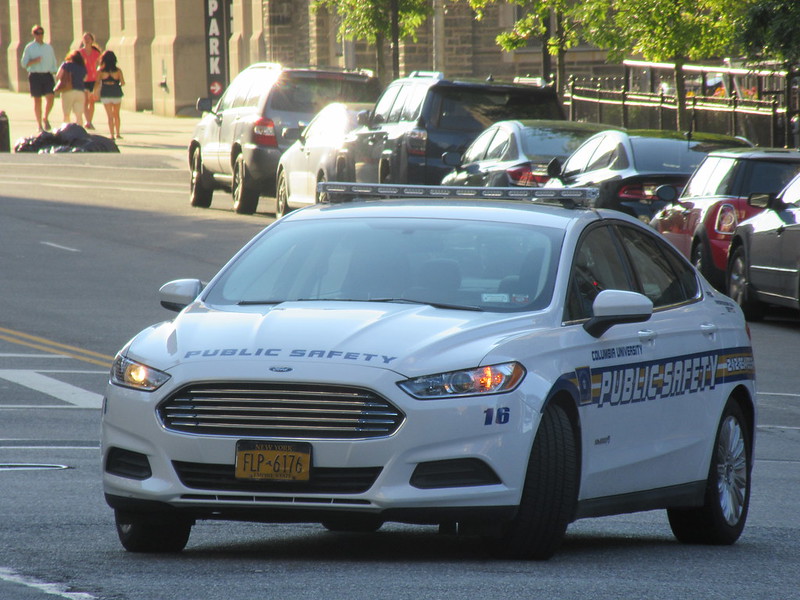
Photo: “Columbia University Public Safety Ford Fusion” by Andre Gustavo Stumpf is licensed under CC BY 2.0

0 Comments